When Should a Child Start Violin Lessons: Age by Age
Shang Kun 2026-10-11 99
When Should a Child Start Violin Lessons: The Short Answer
When should a child start violin lessons? Most children are ready between ages 4 and 7, and the sweet spot depends less on the calendar and more on three signals: focus span, fine motor control, and willingness to follow a teacher's instructions. At Shang Kun Violin (Beijing), we've taught hundreds of families, and the kids who thrive at 4 or 5 usually show all three signals. The kids who start at 7 or 8 often catch up fast because they can read, sit still, and self-correct. Neither path is wrong. What matters is matching the start age to the child, not to a neighbor's kid.
A quick word on cost before we go further, since parents always ask: in Beijing, in-person violin lessons for children usually run 300–600 RMB per 45-minute session with a teacher from a music conservatory background. Online lessons through our studio typically cost 200–400 RMB per session, and a 10-lesson package often brings the per-session price down by 10–15%. ABRSM-track coaching costs more, usually 500–800 RMB per session, because it involves exam repertoire, sight-reading, and aural training.
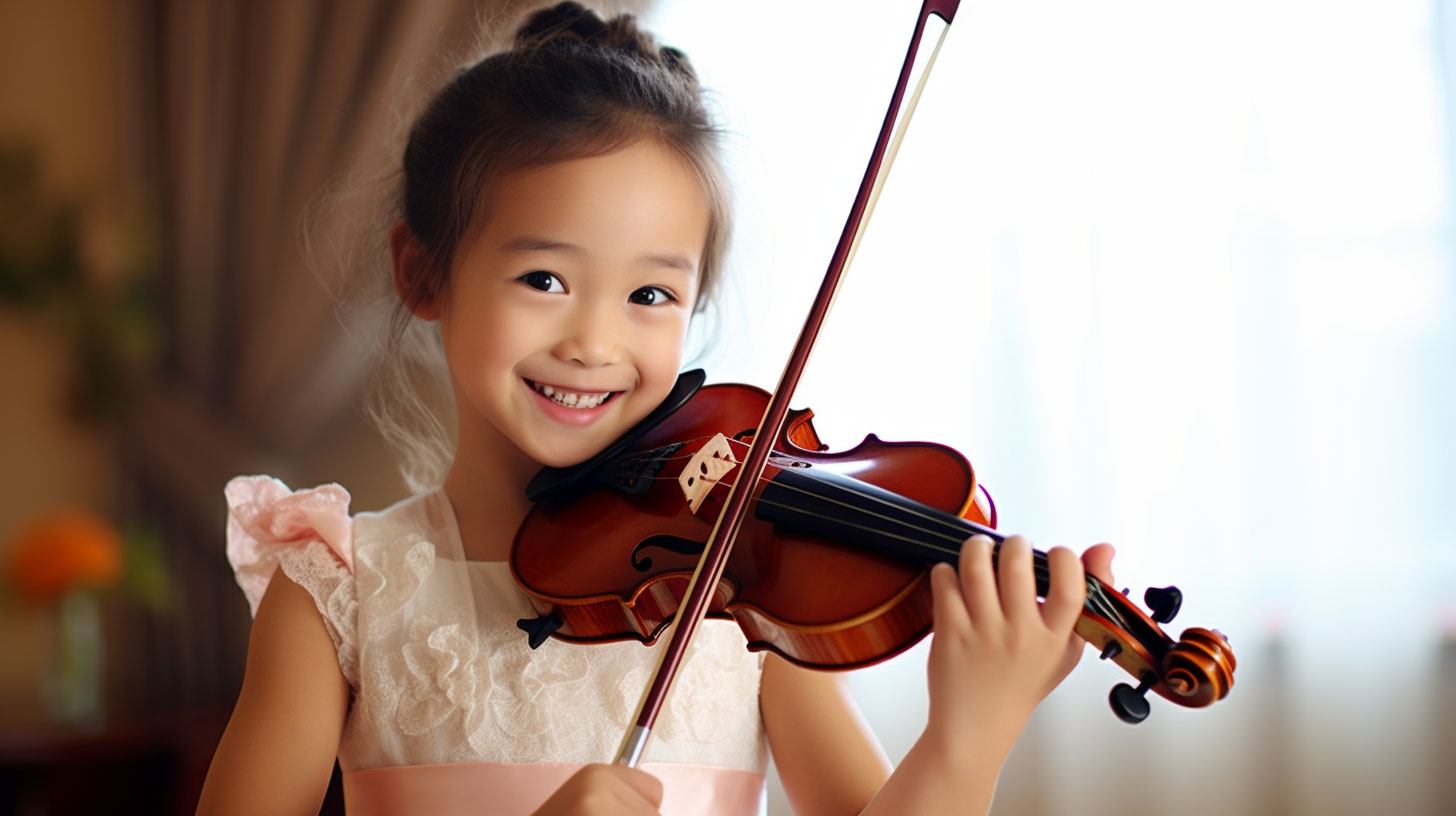
Age 4–6 vs Age 7+: The Real Trade-Offs
What Younger Beginners Gain
Kids who start at 4–6 build muscle memory early. Their ears absorb pitch and rhythm almost passively, and by age 8 they can sound surprisingly polished. The downside? They tire fast. A 30-minute lesson is realistic; 45 minutes usually ends in tears or fidgeting. Progress is slow at first, maybe three months just to hold the bow correctly. Parents need to sit in on practice every day for the first year. If you can't commit that time, wait.
What Older Beginners Gain
Kids starting at 7 or 8 understand cause and effect. Tell them "your elbow is too low" and they can fix it without a mirror. They read music faster, practice more independently, and often pass Grade 1 within 12–18 months. The trade-off is that a 10-year-old beginner may feel self-conscious next to a 6-year-old who plays Vivaldi. That's a social issue, not a technical one, and it fades once they catch up. For a deeper checklist on matching age to teacher style, read our age bands guide for when children should start violin lessons.
Three Readiness Signals That Matter More Than Age
Signal 1: Can They Focus for 15 Minutes?
This is the big one. A child who can sit through a 15-minute story or puzzle without wandering off can usually handle a 30-minute violin lesson. If they can't, they're not ready, no matter how musical they seem. Try a few trial lessons before buying an instrument.
Signal 2: Can They Use Scissors and Hold a Pencil?
Fine motor control develops at different rates. A child who can cut along a line and grip a pencil with three fingers has the hand control for bow hold and finger placement. If they still palm the pencil, give it six months. We've seen 5-year-olds with better bow control than some 8-year-olds, and vice versa.
Signal 3: Do They Respond to Correction?
Violin lessons involve constant correction. A child who melts down every time the teacher says "try again" will hate lessons. A child who shrugs and tries again will improve fast. This signal is about temperament, not talent. If your child hates being corrected, consider group classes first, where feedback feels less personal. Our readiness signs article breaks this down further with examples from real students.
Violin Sizes by Age: A Practical Chart
Never buy a full-size violin for a young child. The instrument must fit under the chin with the left arm fully extended and the palm cradling the scroll. Here's the chart we use at our Beijing studio:
1/16 size: ages 3–4, arm length under 35 cm. 1/8 size: ages 4–5, arm length 35–38 cm. 1/4 size: ages 5–7, arm length 38–43 cm. 1/2 size: ages 6–8, arm length 43–48 cm. 3/4 size: ages 8–11, arm length 48–52 cm. 4/4 full size: ages 11+ or arm length over 52 cm.
When in doubt, size up only if the child can hold the violin parallel to the floor without lifting the left shoulder. A violin that's slightly too small is better than one that's too big. Most rental programs let you trade up every 12–18 months, which is cheaper than buying each size new. A decent 1/4-size student violin in Beijing costs 800–1,500 RMB; a 4/4-size student model runs 1,200–2,500 RMB.
How Often Should a Child Take Lessons Each Week?
Beginners: Once a Week Is Enough
For the first six months, one 30-minute lesson per week plus 10–15 minutes of daily practice at home works fine. The lesson introduces new material; the daily practice cements it. Two lessons a week for a 5-year-old is usually overkill and burns them out.
Intermediate: Once or Twice a Week
Once a child can play a one-octave scale and simple tunes, consider adding a second weekly lesson or a group class. At this stage, 20–30 minutes of daily practice makes a visible difference. If your child is preparing for ABRSM Grade 1–3, two lessons a week can help, but only if they practice between them. Otherwise it's wasted money.
Advanced: Two or Three Times a Week
Serious students aiming for Grade 5 and above often need two private lessons plus one ensemble or theory class per week. That's a big commitment. Before you sign up, read our weekly practice frequency guide to see what the practice load actually looks like at each level.
What About Online Lessons for Young Beginners?
Online lessons work surprisingly well for kids aged 6 and up, especially if a parent is nearby to help with tuning and posture. For 4–5 year olds, online is hit or miss. They need hands-on adjustment that a screen can't provide. We usually recommend starting in person for six months, then switching to online if your schedule demands it. Our article on online lesson effectiveness for kids explains how to tell if the format is working.
One concrete detail: we ask online families to set up two cameras if possible, one for the bow arm and one for the left hand. That single change improves correction speed by a lot. It's not mandatory, but it helps.
Frequently Asked Questions
Q: Can a 3-year-old start violin lessons?
A: Some can, but it's rare. At 3, most children lack the focus and fine motor control for a standard lesson. We usually suggest starting with a preschool music class and switching to violin at 4 or 5. If your 3-year-old can focus for 15 minutes and follow simple instructions, a 15-minute trial lesson is worth trying.
Q: Is it too late to start violin at 10?
A: No. Starting at 10 is perfectly fine. Older beginners often progress faster because they can read, self-correct, and practice independently. The main challenge is social, not technical. Many 10-year-old beginners reach Grade 3 within three years.
Q: How do I know which violin size to buy?
A: Measure from the neck to the middle of the left palm with the arm extended. Match that measurement to the size chart above. When in doubt, choose the smaller size. A violin that's slightly too small won't hurt technique; one that's too big will.
Q: Should my child practice every day?
A: Yes, but keep it short. For beginners, 10–15 minutes daily beats 30 minutes twice a week. Consistency matters more than duration. At age 4–6, a parent should practice alongside the child.
Q: What if my child wants to quit after three months?
A: Three months is often the hardest stretch because progress feels slow. Before quitting, try changing the lesson format, the teacher, or the practice routine. If your child still hates it after a fair trial, let them stop. Forced practice rarely produces a lifelong musician.
Q: Do I need to attend my child's lessons?
A: For ages 4–6, yes. You'll need to help with tuning, posture, and daily practice at home. For ages 7 and up, you can sit in occasionally but should gradually step back so the child learns to take responsibility.
Q: How much should I budget for violin lessons per month?
A: In Beijing, expect 1,200–2,400 RMB per month for weekly in-person lessons, or 800–1,600 RMB for weekly online lessons. Add 100–300 RMB per month for strings, rosin, and occasional repairs. Rentals usually run 50–150 RMB per month for child sizes.
Related Reading
If you're choosing a teacher, start with our checklist for choosing a violin teacher for your child. For practice planning, see the weekly practice plan for children. Families abroad may find our guide to online violin lessons for Chinese families overseas useful. And if you're evaluating whether online lessons are worth it, read this honest breakdown.
