How Often Should a Child Practice Violin? Ages 5-10
Shang Kun 2026-10-07 221
How Often Should a Child Practice Violin? Ages 5-10
How often should a child practice violin depends less on talent and more on age, attention span, and how the weekly minutes are arranged. At Shang Kun Violin (Beijing), we teach students ages five to ten both online and in person, and the pattern we see is consistent: five short sessions beat one long weekend session almost every time. For ages 5-6, aim for 10-15 minutes a day, 4-5 days a week, roughly 50-70 minutes total. For ages 7-8, aim for 20-25 minutes a day, 5 days a week, roughly 100-125 minutes total. For ages 9-10, aim for 30-40 minutes a day, 5 days a week, roughly 150-200 minutes total. These are starting ranges, not rules carved in stone. A child who is preparing for an ABRSM Grade 2 exam may need the upper end; a child who started three months ago should stay at the lower end. One concrete reference point: our online one-on-one lessons run 30 or 45 minutes, and most families pair one lesson a week with four short home sessions.
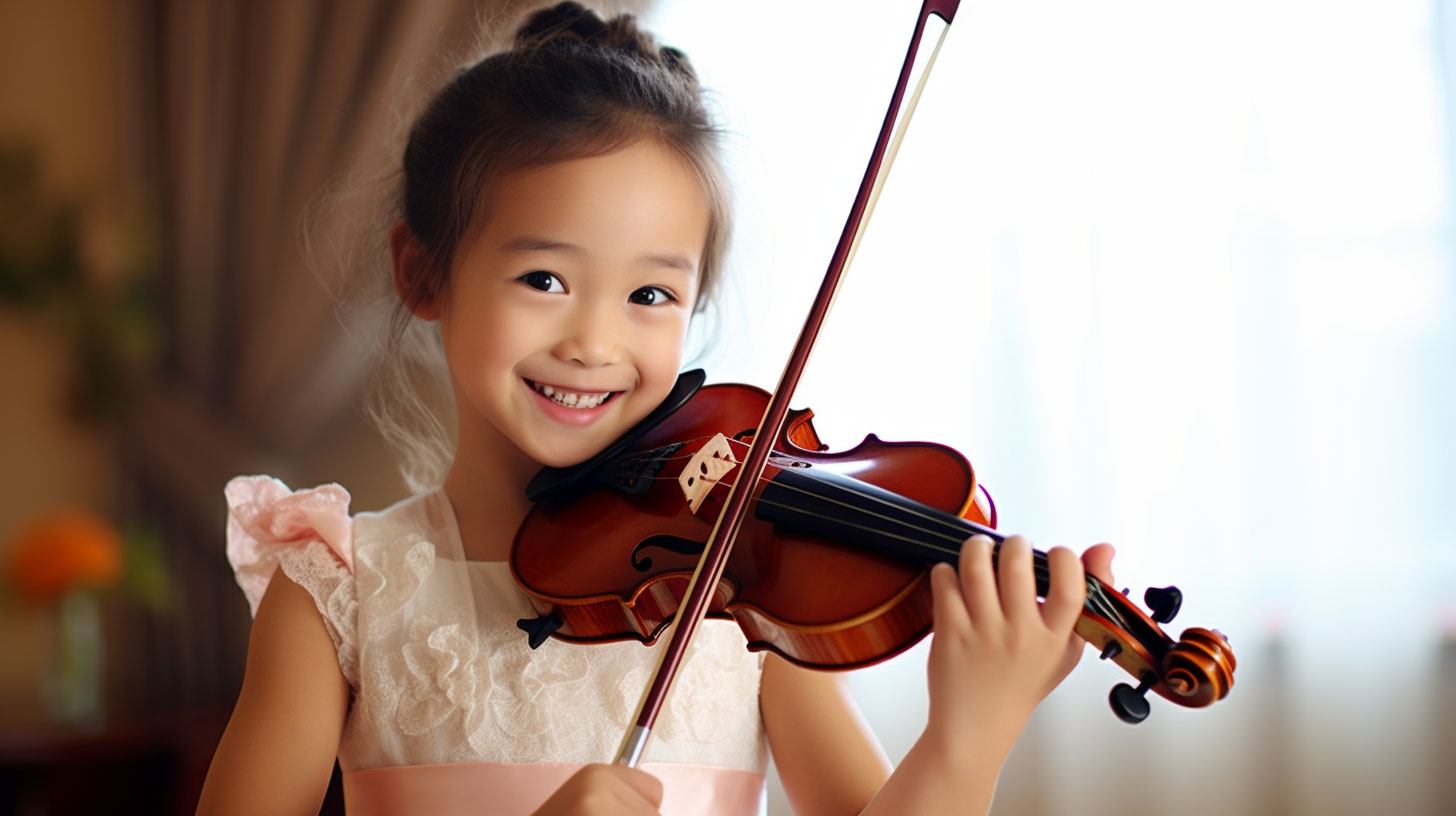
Parents often ask whether 15 minutes a day is even worth the setup time. It is. The bow arm and left-hand fingers learn through repetition with rest in between, which is exactly what daily short sessions provide. Skipping Monday through Friday and grinding through 90 minutes on Saturday gives a child a sore neck, a short temper, and very little durable muscle memory. The rest days matter as much as the playing days.
Weekly Minutes by Age Band: 5-6, 7-8, 9-10
Think in weekly totals first, then divide them into days. This makes it easier to adjust when a school week gets heavy.
Ages 5-6: 50-70 minutes per week
Ten to fifteen minutes a day is plenty. At this age, the goal is posture, bow hold, and a sense of steady pulse. Many five-year-olds can focus for eight minutes before losing the thread, so two tiny sessions in one day, one before dinner and one after, can work better than one longer one. Count the week in sessions, not minutes. Four or five sessions is a good week. If your child hums the rhythm while putting the violin away, that is a sign the session landed.
Ages 7-8: 100-125 minutes per week
Twenty to twenty-five minutes a day, five days a week. This is the age where a practice chart becomes genuinely useful, not as a reward system but as a visible record. Children this age start to hear their own intonation and can correct a sharp or flat note with a little prompting. They can also handle a short review of last week's material plus one new thing, which is the basic shape of a healthy session. If a child is learning with an online violin teacher for kids, parents should expect the teacher to send a short note after each lesson listing exactly what to practise before the next one.
Ages 9-10: 150-200 minutes per week
Thirty to forty minutes a day, five days a week. By nine or ten, many students can hold focus for a full 30 minutes and can be trusted to run part of the session alone. This is also the age where repertoire grows faster than technique, and the temptation to skip scales appears. Do not skip them. Ten minutes of warm-up and technique protects the next twenty minutes of pieces. Students preparing for graded exams often add a sixth day, usually a lighter review day of 15-20 minutes.
Why Short Daily Sessions Beat One Long Weekend Session
Motor learning needs sleep. A child who practises a new bowing pattern on Tuesday, sleeps on it, and returns to it on Wednesday is building a skill in a way that a single Saturday marathon cannot match. Three specific reasons parents notice quickly:
First, stamina. A 7-year-old practising for 90 minutes straight is not practising for 90 minutes. After about 25 minutes, posture collapses, the bow starts sliding toward the fingerboard, and the last 40 minutes reinforce mistakes. Second, mood. Short sessions end before frustration peaks, which keeps the violin from becoming the thing that ruins the afternoon. Third, retention. Reviewing a passage on five separate days gives the brain five chances to encode it; reviewing it once gives one.
There is one exception worth naming. If your family schedule truly only allows weekend practice, two 30-minute sessions on Saturday and Sunday, with a 10-minute review on two weekday evenings, still beats a single 90-minute block. Split it rather than stacking it.
How to Split a Session: Warm-Up, Technique, Repertoire
A session has three jobs, and the proportions shift with age. For a 15-minute session, use 3 minutes warm-up, 5 minutes technique, 7 minutes repertoire. For a 25-minute session, use 5 minutes warm-up, 8 minutes technique, 12 minutes repertoire. For a 40-minute session, use 7 minutes warm-up, 13 minutes technique, 20 minutes repertoire.
Warm-up (3-7 minutes)
Open strings with long bows, then a simple rhythm on one string. The point is to wake up the bow arm and check that the instrument is in tune and the shoulder rest is in the right place. A child who starts with repertoire usually spends the first five minutes sounding worse than they actually are.
Technique (5-13 minutes)
Scales, arpeggios, and one focused etude or exercise. Pick one technical target per week, such as keeping the left elbow under the violin or keeping the bow parallel to the bridge. Writing it on a sticky note on the music stand works better than repeating it verbally.
Repertoire (7-20 minutes)
One current piece and one review piece. Work in small windows: two bars, then four, then the phrase together. End with something the child can already play well. Finishing on a piece that sounds good sends the child away wanting to come back tomorrow.
Two Ready-to-Use Weekly Plans
Plan A: Ages 5-6, total 60 minutes
Monday: 12 minutes. Warm-up open strings, bow hold game, one short song. Tuesday: rest. Wednesday: 12 minutes. Review Monday's song, clap a new rhythm, play it on one string. Thursday: 12 minutes. Warm-up, two easy pieces. Friday: rest. Saturday: 12 minutes. Play everything learned this week, once each. Sunday: 12 minutes. Free choice, child picks the songs. If a day is rough, cut it to 6 minutes and stop. Consistency beats duration at this age.
Plan B: Ages 9-10, total 180 minutes
Monday: 35 minutes. 7 warm-up, 13 scales and etude, 15 repertoire. Tuesday: 35 minutes. Same shape, new passage in the current piece. Wednesday: 30 minutes. Lighter day, review only, plus rhythm reading. Thursday: 35 minutes. Technique focus, then run the piece in sections. Friday: rest or 15-minute run-through. Saturday: 45 minutes. Full run-through, record it on a phone, listen back once. Sunday: rest. Recording once a week is one of the most useful habits a nine-year-old can build, and it costs nothing.
Signs a Child Is Over-Practising
More is not automatically better. Watch for these signals, and treat any one of them as a reason to cut back for a week.
Pain in the left wrist, shoulder, or neck that lasts past the session. Sore fingertips are normal in small doses; joint pain is not. Mood changes that appear only before practice, such as stomach aches, tears at the same point every session, or sudden excuses. A drop in accuracy on pieces the child could play last month, which usually means fatigue rather than lost skill. Trouble falling asleep on practice days, especially when practice happens after 7 p.m. A child who starts avoiding the violin room entirely. If two or more of these appear, drop to half the usual minutes for five days and talk to the teacher. A short break rarely costs progress, but a strained wrist can cost months. Parents who are unsure whether an issue is technical or fatigue-related can book a short check-in through an online violin lesson for kids and get a second opinion without changing teachers.
What Parents Should Do During Practice
Stay nearby for ages 5-6, ideally within sight. For ages 7-8, check in at the start and the end. For ages 9-10, let the child run the session and review the notes afterward. Do not correct intonation from the doorway unless the teacher has asked you to; mixed instructions confuse young players. Do keep a simple log, either on paper or in a notes app, with date and one sentence about what was practised. Teachers can plan the next lesson far better with that log in hand.
One more practical detail: tune the violin before the session, not during it. A five-minute tuning fight eats a third of a young child's practice time. If your child is learning online, check the online 1 on 1 violin lesson setup guide so the camera angle shows both hands, and keep a spare set of strings at home. Strings in Beijing typically cost 60-200 RMB per set for student instruments, and a broken string on a Sunday evening should not cancel Monday's practice.
Q: How many days a week should a 6-year-old practise violin?
A: Four or five short days, 10-15 minutes each. Two rest days are fine and often helpful. If your child is exhausted after school, a 6-minute session still counts.
Q: Is 30 minutes a day too much for a 7-year-old?
A: For most 7-year-olds, 20-25 minutes is the sweet spot. Thirty minutes can work if it is split into two 15-minute blocks with a break, but watch for posture collapse in the last five minutes.
Q: Can we make up missed practice on the weekend?
A: Partly. One longer weekend session can replace one missed weekday, but it cannot replace four. Split the weekend session into two blocks of 20-30 minutes rather than one long sitting.
Q: Should practice happen before or after school?
A: Before school works well for some families because the child is fresh, but it requires an early start. After school is more common. The key is a fixed time, not a perfect time. Right before bed is the worst slot.
Q: How do I know if my child needs more practice time?
A: If the teacher reports that pieces are learned but not secure, or if the child can play a passage slowly but not at tempo, add 5 minutes to four days rather than one big block. Ask the teacher to set the target.
Q: What if my child refuses to practise at all?
A: Shrink the session. Five minutes with one clear goal is better than a 25-minute argument. If refusal lasts more than two weeks, talk to the teacher about the repertoire and the lesson format. Sometimes the issue is the material, not the instrument.
Related Reading
How often should a child practice violin gives a second angle on weekly minutes and rest days. When should a child start violin lessons covers readiness signs for ages four to seven. How to choose a violin teacher for my child walks through questions to ask before the first paid lesson. Families comparing online and in-person formats can start with the effectiveness of online violin learning for kids. Shang Kun Violin teaches online worldwide and in person in Beijing; lesson slots are 30 or 45 minutes, and trial lessons can be arranged by contacting the studio directly.
