Online Violin Teacher for Chinese Students: What to Expect
Shang Kun 2026-10-05 98
What an Online Violin Teacher for Chinese Students Actually Covers
Choosing an online violin teacher for Chinese students usually starts with one practical question: what happens in the first month? For overseas Chinese families in the US, Canada, the UK, or Australia, the appeal of a Chinese-speaking teacher is obvious. A child can ask a question in Mandarin, the teacher explains bow hold in Mandarin, and parents don't need to translate every instruction after class. But expectation-setting matters here. A Beijing-based teacher working online will not run the same lesson as a neighborhood music school down the street, and that difference is not a flaw. It is the whole point.
Sessions typically run 30, 45, or 60 minutes depending on age and level. A beginner in the 6 to 8 range usually starts with 30 minutes twice a week, while a student preparing for ABRSM Grade 3 or above often moves to 45 or 60 minutes once a week. Rates vary widely by teacher experience and location, but online lessons from Beijing-based teachers commonly fall between 200 and 600 RMB per hour (roughly 28 to 85 USD), with package pricing for monthly commitments. That is a real range, not a sales pitch. Anything far below or above it deserves a conversation about what is included.
The first month has a shape. It is not random. A teacher will normally spend the opening weeks on instrument setup, posture, bow hold, open strings, and simple rhythm. Scales and ear training start almost immediately, often in parallel. If your child comes out of lesson one knowing how to stand, how to hold the bow, and how to play four open strings with a steady tone, that is a solid start. If they come out with a page of notes to memorize but no idea how to hold the instrument, something is off.
How Online Lessons Differ From a Local Teacher
The obvious difference is the screen. The important differences are subtler.
A local teacher can physically adjust a child's elbow or wrist. An online teacher has to talk the child through the adjustment and rely on camera angles. This is slower at first, and it demands a bit more from the student. In exchange, families get access to teachers trained in the Chinese conservatory tradition, often with experience preparing students for ABRSM, Trinity, and competition repertoire. For families who want Mandarin instruction and a structured technical foundation, that trade-off is usually worth it.
Another difference is pacing. Local teachers may see a student once a week for 30 minutes and move at the school's rhythm. Online teachers working with overseas Chinese families often build a more individualized plan because the lesson time is precious and the parent is usually nearby. That can mean faster progress, or it can mean the teacher slows down and fixes habits before moving on. Both are legitimate. The key is whether the teacher tells you which approach they are using.
There is also the question of continuity. Online lessons are easier to reschedule when a family travels, and easier to keep during school holidays. For families who move between cities or countries, that stability matters more than most people admit.
Hand Size, Instrument Fit, and Why It Matters Early
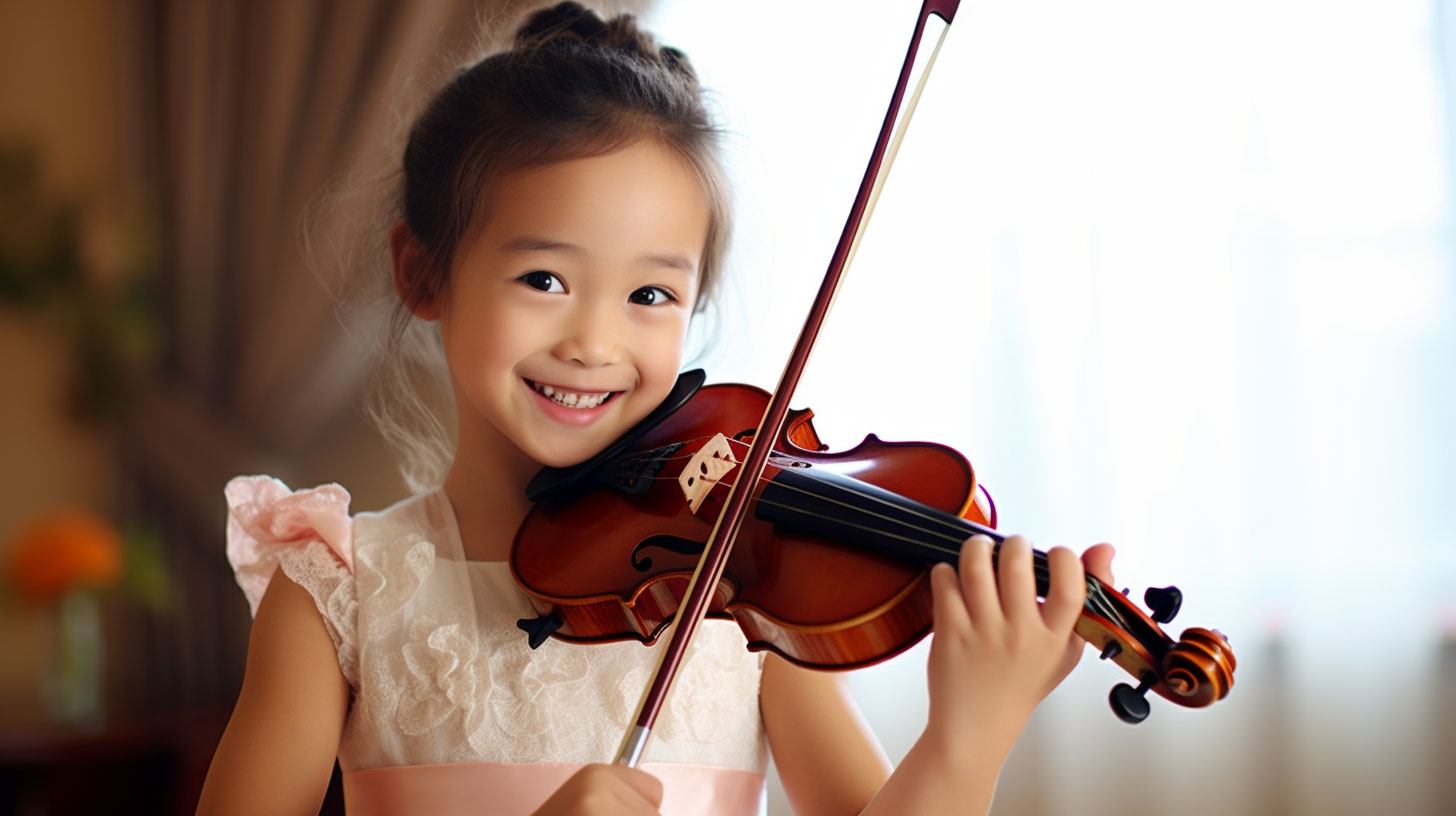
Hand size comes up in almost every first conversation. Parents worry a small hand means the child is not ready. That is rarely true. Violins come in fractional sizes, and the correct fit depends on arm length and finger span, not age alone. A 1/4 size violin might suit a five-year-old with a longer reach, while a seven-year-old with shorter arms may still need a 1/4 or 1/2.
Teachers usually check three things: can the child hold the violin under the chin without lifting the left shoulder, can the fingers reach the correct notes in first position without stretching, and can the bow arm extend comfortably. If any of these fail, the instrument is the wrong size. Using a violin that is too large causes tension, bad intonation, and eventually a child who dreads practice.
Parents often buy a larger violin hoping the child will grow into it. That plan backfires. A quick read of this violin size guide for parents will save you from that mistake. Measure the arm, match the size, and revisit it every six to twelve months.
Focus Span: What to Expect From a Young Beginner
Young children have short attention spans. This is not a discipline problem. It is normal development. A five- or six-year-old can generally focus on one task for five to ten minutes before needing a change. A well-trained online teacher builds lessons around this. They switch between bow exercises, rhythm clapping, listening games, and short pieces so the child stays engaged without feeling rushed.
If a teacher expects a six-year-old to sit still and drill scales for 30 minutes straight, that is a warning sign. The result is a child who associates violin with fatigue. A better approach uses small blocks, frequent praise, and clear stopping points. Parents should hear the teacher naming what went well, not just what went wrong.
At home, practice sessions should mirror this. Ten focused minutes a day beats a forced 40-minute session once a week. Consistency wins over intensity every time.
Ear Training: The Part Parents Underestimate
Ear training is not an extra. It is part of the foundation. From the first month, a good teacher will include pitch-matching, singing simple intervals, and identifying high versus low notes. This is not busy work. It directly shapes intonation later, when the child has to adjust fingers without a teacher saying "higher" or "lower" every time.
Children who train their ears early tend to play more in tune and learn pieces faster. They also become better at self-correcting. That independence is the goal. A teacher who only trains fingers and never trains the ear is leaving half the job unfinished. If you want to understand how this plays out at home, the ideas in this reading music vs playing by ear article are useful for parents trying to support practice.
Why Earlier Is Not Automatically Better
There is a quiet competition among parents about how young a child can start violin. Three years old? Four? It sounds impressive. It rarely helps.
Before age five or six, most children lack the fine motor control to hold a bow correctly, the attention span to follow instruction, and the patience to repeat a single motion. Starting too early can build habits that take months to undo. A child who starts at six with good posture and steady practice often overtakes a child who started at four with a rushed, tension-filled foundation.
Readiness signals matter more than birthdays. Can the child follow a two-step instruction? Can they clap a simple rhythm back? Can they stand still for five minutes? Do they show interest when music plays? If the answers are mostly yes, they are ready. If not, waiting six months costs nothing. The article on at what age a child should begin violin walks through this in more detail.
Concrete First-Lesson Readiness Signals
Before the first online lesson, run through a short checklist. It takes ten minutes and prevents a lot of frustration.
Instrument and Setup
The violin is the correct size, the bow is not warped, the shoulder rest fits, and the strings are not dead. Rosin is available. A music stand is helpful but not mandatory in week one.
Space and Technology
A quiet room with decent lighting. A phone or laptop on a stable stand at roughly chest height. A stable internet connection. Headphones help if there is background noise. The camera should show the child from the side and front, not from above.
Child Readiness
The child can follow simple directions, can stand for a few minutes without complaint, and is not hungry or exhausted at lesson time. Schedule lessons when the child is usually alert, not right before bed.
Parent Readiness
A parent or caregiver sits nearby for young beginners. Not to teach, but to help with setup, mute the microphone when needed, and write down two or three practice points after the lesson. Teachers notice when a parent is engaged. It changes how much ground gets covered.
What the First Month Should Look Like
Week one is setup and sound. Posture, bow hold, open strings. No songs yet, maybe a rhythm game.
Week two adds simple bowing patterns and the first notes on the A string or D string. Ear training continues.
Week three introduces a short piece or exercise that uses two or three notes. The child starts to connect reading, listening, and playing.
Week four reviews everything and sets a small goal for the next month. If your teacher has not set any goal by week four, ask for one. Goals keep lessons honest.
This timeline shifts with age and practice. A seven-year-old practicing daily moves faster than a five-year-old practicing twice a week. Neither is behind.
Beijing-Based Teaching Options and What They Offer
Beijing has a deep pool of violin teachers trained in conservatory systems, and many now teach online for overseas Chinese families. This means access to Mandarin instruction, familiarity with Chinese and Western teaching methods, and experience preparing students for ABRSM and other graded exams.
For families in North America, the time difference is workable. Beijing is roughly 12 to 13 hours ahead of the US East Coast, so morning or early afternoon slots in Beijing line up with evening slots on the East Coast. West Coast families often prefer early morning Beijing time. Teachers who work with overseas students usually keep a few flexible slots for this reason.
If you want to see how other families in the US and Canada structure their lessons, this overview of online violin lessons for kids in the US and Canada is a good starting point. It covers scheduling, expectations, and how to keep progress steady across time zones.
Common Questions From Parents
Q: How long before my child can play a simple song?
A: Most beginners play a short, recognizable piece within four to eight weeks if they practice a few minutes a day. Children who practice only once a week usually take longer, not because of talent but because the fingers need repetition.
Q: Is 30 minutes a week enough for a six-year-old?
A: For a young beginner, two 30-minute lessons per week often work better than one 60-minute lesson. Short, frequent sessions match how young children learn and keep focus high.
Q: What if my child's hand is small?
A: Hand size is rarely a reason to delay. It is usually a reason to check the violin size. A correct fractional instrument and a proper shoulder rest solve most reach problems.
Q: Do we need a piano at home for ear training?
A: No. A teacher can use pitch-matching, singing, and simple apps. A keyboard helps but is not required for the first year.
Q: How do I know if the online teacher is a good fit?
A: Watch how the teacher handles mistakes. Good teachers slow down, isolate the problem, and give one clear instruction. If your child finishes a lesson knowing exactly what to fix, the fit is probably good.
Q: Should we start with group lessons or private lessons?
A: For beginners under eight, private lessons usually build technique faster. Group lessons can be a nice supplement later for ensemble experience. The comparison in this group vs private violin lessons article breaks down the trade-offs.
Related Reading
How to choose a violin teacher for my child
Is online violin learning effective for kids?
How often should a child practice violin?
Violin intonation practice tips
Shang Kun Violin (Beijing) works with overseas Chinese families who want Mandarin-language instruction and a structured technical foundation. If you are comparing options, ask about lesson length, practice expectations, and how the teacher plans the first month. Those three answers tell you more than any promotional page.
