Beginner Violin: Your First Three Months
Shang Kun 2026-10-01 161
If you are searching for beginner violin guidance, the first three months will shape almost everything that follows. Most new players in Beijing ask the same question: what should actually happen between week one and week twelve? This guide answers that single question. No vague encouragement, just the real sequence of skills, the money involved, and the mistakes that slow people down.
Here is the short version. In three months, a typical adult beginner taking one 45-minute lesson per week and practicing 20-30 minutes on five days will finish with a stable bow hold, a usable left-hand frame, the ability to play one-octave scales in G, D and A major, and two or three short pieces from memory. A child aged 7-10 usually moves a bit faster on rhythm and a bit slower on tone, because small hands need more time to build strength. Either way, expect roughly 40-60 total practice hours by the end of month three.
Cost matters, so let's put numbers on the table early. In Beijing, individual beginner violin lessons run about 200-400 RMB per 45 minutes with a teacher from a music conservatory background, and 150-250 RMB for a student teacher or a group class of four to six people. Online lessons through a Chinese teacher typically sit at 150-300 RMB per session. A first full-size or 3/4 violin outfit (instrument, bow, case, rosin, shoulder rest) costs 1,200-3,000 RMB. Add roughly 200-400 RMB for a tuner, music stand and extra strings. A realistic three-month budget for a dedicated beginner in Beijing lands between 3,500 and 6,000 RMB including the instrument.
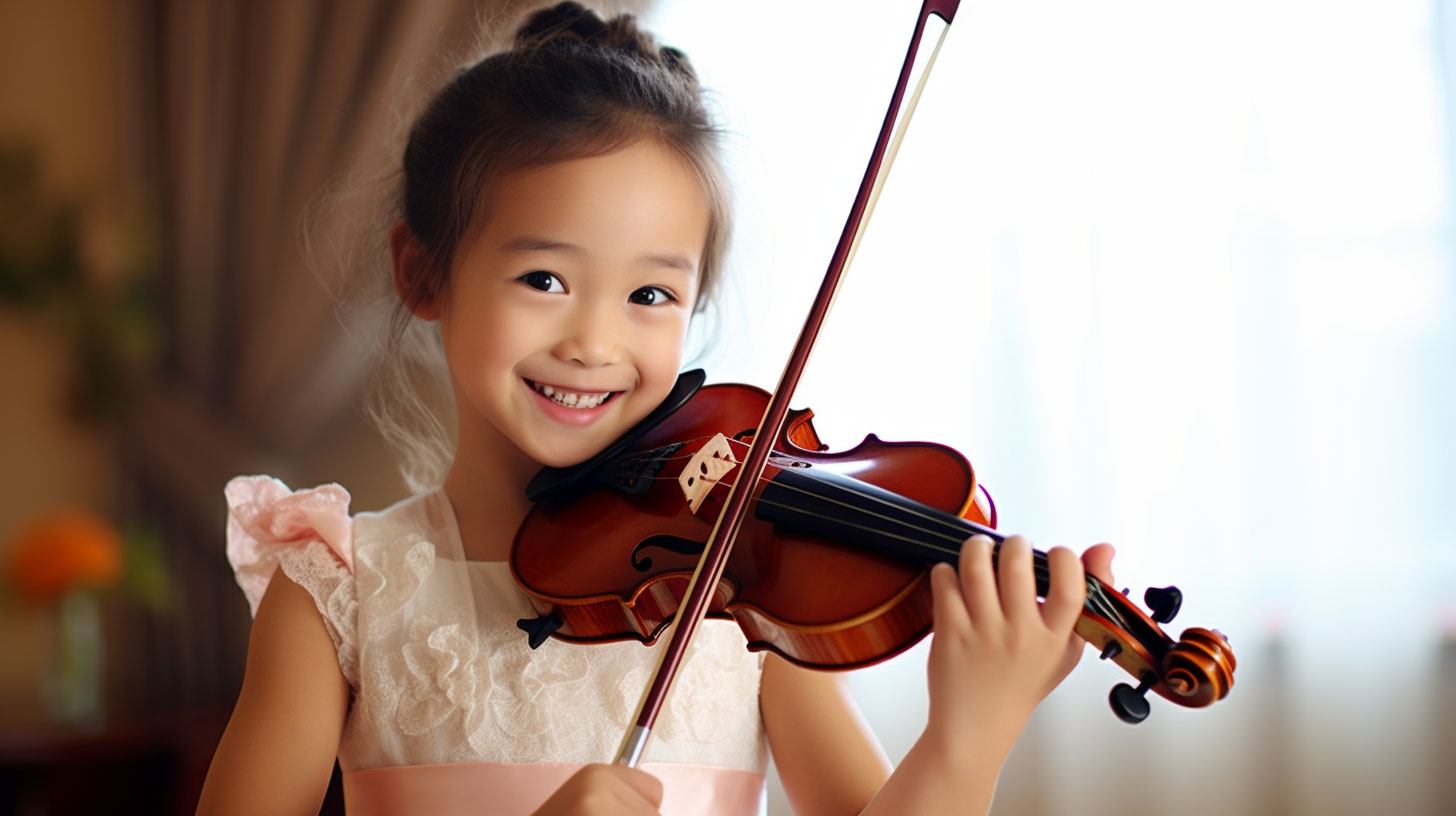
What should month one of beginner violin actually look like?
Month one is not about playing songs. It is about building a body relationship with the instrument. If your teacher spends the first two lessons on posture, instrument position and bow hold, that is a good sign, not a waste of time.
Posture, holding position, and the first sound
You will learn to stand or sit with the violin resting on the collarbone, the chin lightly on the chinrest, the left elbow under the instrument and the scroll roughly at eye level. The bow hold is a curved, relaxed hand with the thumb bent and the pinky resting on top of the frog. Most beginners grip too hard for the first three weeks. That is normal, and your hand will ache slightly.
Then you make your first open-string sounds. Open A and open D, long slow bows, maybe four seconds per bow stroke. Your teacher will watch for a straight bow path between the bridge and the fingerboard. A beginner's bow tends to drift toward the fingerboard, producing a thin whistle. Correcting that early is far easier than fixing it in month six.
By the end of month one, everything should be played pizzicato or with very short, separate bows. No slurs. No shifting. No vibrato. If someone promises vibrato in the first month, they are skipping foundations.
How much should you practice in the first four weeks?
Fifteen to twenty minutes a day, five days a week. More than that and your bow arm gets sore in ways that build bad habits. Do it in two short blocks if sitting still is hard. Practicing six days out of seven for fifteen minutes beats one 90-minute session on Sunday.
If you want a deeper breakdown of session structure, this guide on violin practice time: how much is enough goes into realistic numbers for different ages.
What changes in month two of beginner violin?
Month two is where notes start appearing on the page and under your fingers. You will learn the first-position finger pattern on all four strings and begin reading simple notation.
First-position finger patterns and intonation
Most teachers start with the pattern on the D and A strings: open string, first finger, second finger, third finger. That pattern is a whole step, a whole step, a half step. Play it slowly. The third finger is the one that lands sharp for almost everyone, because the finger is weaker.
Intonation in month two is rough. Expect it. Use a tuner as a reference for a few minutes per session, not as a crutch. Play a slow scale and listen for the ringing quality when a note is in tune. That ring is real, and once you hear it you will chase it.
If reading music is slowing you down, violin sight-reading for beginners in Beijing covers the specific drills that build fluency without memorizing finger numbers.
Your first bowing patterns
Month two introduces detache, which simply means separate bows with a smooth change of direction. You may also meet the eighth-note rhythm with two notes per bow. Keep the upper arm quiet and let the forearm do the work near the frog. Watch your elbow, not your hand.
This checklist on violin bowing basics is worth reading before your next lesson, because bow control is the single biggest difference between a beginner who sounds decent and one who sounds scratchy.
What should you be able to play by month three?
By the end of month three, a typical beginner can play one-octave scales in G, D and A major, and two or three short pieces. Common choices are "Twinkle, Twinkle, Little Star," "Lightly Row," "Song of the Wind," or the first pieces in Suzuki Book 1. Adult beginners often prefer folk tunes or simplified pop melodies, and that is fine.
Scales, pieces, and reading level
Scales are not optional. They teach your ear and your hand the geography of the instrument. Five minutes of G major daily will do more for your intonation than an extra twenty minutes of a piece you already know.
Reading level after three months is roughly: quarter notes, half notes, eighth notes, rests, and simple key signatures with up to two sharps. You should be able to clap a rhythm and then play it without your teacher saying every note.
Can you play with others yet?
Yes, in a simple way. Two beginners playing a unison melody together is a great month-three activity. It exposes rhythm problems fast. Some Beijing studios run a monthly beginner group class exactly for this reason, and it costs far less than private lessons.
If you want to know what a structured beginner class looks like before committing, read beginner violin classes in Beijing: what to expect.
How do you choose a teacher for the first three months?
The teacher matters more than the instrument in the first three months. A good beginner teacher corrects posture constantly, assigns short specific tasks, and does not let you rush into repertoire.
Ask two questions before you book. First, how many complete beginners have you taken through the first three months? Second, what exactly will I be able to play after twelve weeks? A vague answer is a warning.
In Beijing, teachers are available through conservatory-affiliated studios, private teaching, and online. If you are comparing options, choosing a violin tutor in Beijing lays out the questions that separate a real teacher from a hobbyist. For budget planning, violin lesson prices in Beijing explained gives current ranges by format. Parents specifically should read violin lessons for kids in Beijing: a parent guide, since a child's first three months need a different pace and a different practice routine at home.
What slows beginners down in the first twelve weeks?
Three things, over and over. Skipping practice days, then trying to catch up in one long session. Playing too fast too early. Buying an instrument that will not stay in tune.
A violin that slips out of tune every ten minutes destroys your ear training. If your pegs slip or your bridge is leaning, take it to a shop before your next lesson. In Beijing, most music shops near the conservatories do a basic setup check for 50-150 RMB.
Another common trap is comparing yourself to YouTube children who started at four. They have thousands of hours. You have twelve weeks. Compare yourself to your own recording from three weeks ago instead.
Frequently asked questions about the first three months
Q: How long should I practice beginner violin each day?
A: Twenty to thirty minutes, five days a week, is plenty in the first three months. Split it into two sessions if your arm gets tired. Consistency beats length every time.
Q: Can I learn beginner violin without a teacher?
A: You can start, but posture and bow hold are the two things self-taught beginners get wrong most often, and both cause problems that take months to undo. Even one lesson every two weeks with a real teacher makes a large difference.
Q: How much does it cost to start violin in Beijing?
A: Expect 3,500-6,000 RMB for the first three months. That includes a 1,200-3,000 RMB instrument outfit, roughly 200-400 RMB of accessories, and 1,800-3,600 RMB of lessons depending on whether you choose private, group or online format.
Q: What size violin does a beginner need?
A: Adults and teens over about 145 cm use a full-size 4/4. Children need a measured size, usually 1/4, 1/2 or 3/4. A teacher or shop should measure arm length, not guess by age. Details are in choosing the right violin size for a child.
Q: Will my fingers hurt?
A: The fingertips will be tender for two to three weeks until calluses form. Left-hand soreness fades. If you feel sharp joint pain, stop and tell your teacher, because that usually signals too much tension.
Q: How many songs should I know after three months?
A: Two or three short pieces played cleanly, plus scales. Some students manage four or five if they practice daily. Quality of tone and rhythm matters far more than the count.
Q: Can adults start beginner violin at 40 or 50?
A: Yes. Adults often progress faster in the first three months than children because they understand instructions and practice independently. The main adjustment is shorter, more frequent practice to avoid stiffness. See adult violin lessons in Beijing: getting started.
Q: How do I know if my teacher is right for me?
A: After three or four lessons you should understand what you are working on and why. If you leave each lesson with one clear thing to fix, the teacher is doing the job. If every lesson feels like a new random topic, look elsewhere. How to compare violin schools in Beijing can help you structure that decision.
Related reading
A weekly violin practice routine that works gives you a ready-made seven-day plan for the first three months.
Violin practice time: how much is enough answers the question every beginner asks in week two.
Violin scales: how often should kids practice is useful if a young player is in the house.
Violin bowing basics: a beginner checklist covers the bow mechanics that decide how you sound.
How to choose a violin teacher in Beijing walks through the interview process step by step.
Shang Kun Violin (Beijing) teaches beginner violin in person in Beijing and online for students elsewhere, with lessons built around this exact three-month timeline.
