Choosing the Right Violin Size for a Child
Shang Kun 2026-09-30 203
Choosing the right violin size for a child is one of those decisions parents make once every year or two, and getting it wrong can quietly slow a young player down for months. At Shang Kun Violin (Beijing), we measure dozens of kids every term, and the same mistake keeps showing up: parents buy a violin for the child to "grow into" instead of one that fits today. That single habit causes collapsed left wrists, crooked bows, and a kid who says the instrument hurts. None of that is a talent problem. It is a size problem.
Here is the short version before we get into details. A violin that is too big for a child forces the left arm to straighten and the shoulder to lift. A violin that is too small makes the bow arm feel cramped and the fingers crowd together. Both feel wrong to a beginner, who usually cannot explain why.
Why the Right Size Matters More Than the Brand
Parents often come to us with a brand question: which maker, which workshop, which price tier. Fair question, but it comes second. If the size is off by even one step, a well-made violin will still fight the child every time they play.
Think about the left hand first. On a correctly sized violin, a child can place the left hand comfortably at the end of the fingerboard and curve the fingers over the strings without bending the wrist outward. On an oversized violin, the arm runs out of reach. The wrist caves in, the elbow tucks under, and the hand loses its natural arch. That posture is hard to unlearn later.
Now the right arm. The bow should travel roughly parallel to the bridge. On a violin that is too large, the right shoulder rises to reach the tip of the bow, and the bow starts riding toward the fingerboard or over the bridge. On a violin that is too small, the child can play the bow but has no room to develop a full stroke.
What Age Has to Do With It (Less Than You Think)
Age is a rough guide, not a rule. Two eight-year-olds in the same class can need different sizes, because they differ in arm length by several centimeters. Teachers who size by age alone end up wrong often enough to notice.
The measurement that actually matters is arm length, plus a quick check of how the violin sits on the shoulder. Every credible teacher does both in under two minutes. If a teacher only asks the child's age and hands over a 1/2 size, that is a sign to ask more questions.
How to Measure Arm Length at Home
You can do a solid first pass at home before you ever visit a shop. All you need is a tape measure and someone to help hold it steady.
Ask your child to stand relaxed with the left arm extended straight out to the side, palm up, fingers pointing away from the body. Do not let them stretch or shrug. Measure from the middle of the neck, just below where the collarbone meets, out to the center of the palm.
The Standard Arm Length Chart
These ranges are the ones most teachers and shops use. Treat the numbers as bands with soft edges, not hard cutoffs.
A child with an arm length around 35 to 38 cm usually fits a 1/8 size. Around 38 to 42 cm points to 1/4. Around 42 to 47 cm fits 1/2. Around 47 to 51 cm fits 3/4. Above 51 to 52 cm, many children can move to a full-size 4/4, though some teachers keep a growing student on 3/4 for a few extra months if the full-size violin still feels heavy.
Notice the overlap. A child at 41 cm could sit at the top of 1/8 or the bottom of 1/4. This is where the shoulder test decides it. Put both instruments under the chin and watch how the arm bends.
The Physical Test That Confirms the Number
Have your child hold the violin in playing position. The scroll should sit at or slightly past the middle of the left palm when the arm is fully extended along the neck. The elbow should keep a gentle bend, never lock straight.
Then ask them to play an open A string, then D, and reach for G. If reaching G makes the whole shoulder pull forward, the instrument is a step too large. If the palm swallows the scroll and the fingers bunch up, it is a step too small.
One more check: the chin rest should sit on the jawbone, not clamp the throat. A violin that is too big usually puts the chin rest under the chin rather than on it.
Common Sizing Mistakes Parents Make
The biggest one, as mentioned, is buying for future growth. "He will grow into it" sounds practical, but it means six to twelve months of poor posture that has to be corrected later. A correctly sized violin that gets replaced in eighteen months costs less than relearning the left hand from scratch.
Second mistake: buying online without trying. Two violins labeled 1/4 from different workshops can have different body lengths and different neck angles. If the shop cannot tell you the measured body length in millimeters, it is a gamble.
Third: jumping sizes because the child is tall. Height tells you about legs, not reach. A tall child with average arms may still play a 3/4 when a shorter classmate has already moved to 4/4.
Fourth: ignoring the bow. A 3/4 violin paired with a full-size bow is nearly unusable. Bows are sized to match, and the number should appear on both.
If you would like a second opinion on your child's measurements, our studio offers sizing checks during regular lessons. You can read about how our beginner violin classes in Beijing handle the first few weeks, because sizing usually gets revisited around the third or fourth lesson once the teacher sees the child play.
Fractional Sizes Explained Without the Jargon
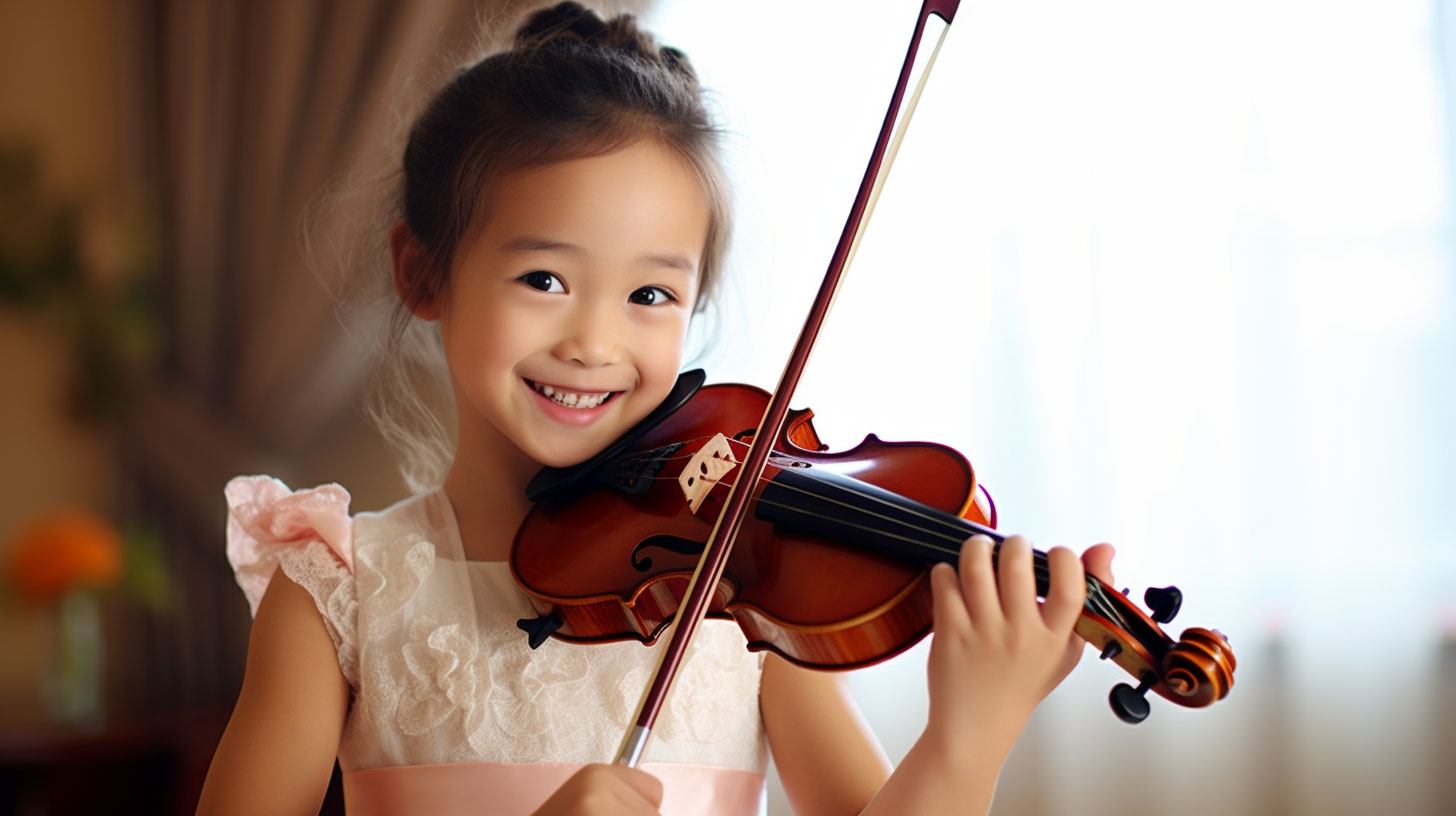
The numbers look backwards at first. A 1/16 is the smallest common size, and 4/4 is full size. The fraction does not represent a real mathematical proportion of a full-size violin, so do not try to reason from it. Just remember: bigger denominator, smaller instrument, with one exception — 3/4 is larger than 1/2.
Common sizes run 1/16, 1/10, 1/8, 1/4, 1/2, 3/4, 4/4. Very young beginners, usually ages four to six, start at 1/16, 1/10, or 1/8. Most primary school students land at 1/4 or 1/2. Teens and adults play 3/4 or 4/4.
When to Move Up a Size
Recheck the arm every four to six months, and always at the start of a new school year. Growth spurts do not announce themselves. A violin that fit in September can feel tight by March.
Signs it is time to move up: the elbow locks straight when reaching first position, the left wrist bends outward to reach the strings, the bow tip keeps clipping the music stand because the arm needs more room, or the teacher simply says the child looks cramped.
Do Not Rush the Last Step to Full Size
A 4/4 violin weighs more and requires a longer bow. Some eleven-year-olds have the arm length for full size but not the shoulder strength. In that case, staying on 3/4 for another term is not a delay. It is protection.
A reasonable rule: move to 4/4 when the arm measures past 51 cm and the child can hold the violin in playing position for two full minutes without the left shoulder creeping up.
Should You Rent or Buy First
For children under ten, renting is often the smarter start, because the size changes every year or two. In Beijing, a fractional-size rental typically runs a few hundred RMB per semester at many shops, with the deposit refundable. Buying makes sense when the child has stayed at one size for a year and practices most days.
If you do buy, expect a reasonable student 1/4 or 1/2 outfit — violin, bow, case — to sit in the low thousands of RMB at a reputable Beijing shop. Full-size student instruments start around the same range and climb with the maker.
What to Bring When You Try Instruments
Bring the child, not just the measurements. Bring the bow they will actually use. Bring a shoulder rest if they have one, because it changes the angle under the chin.
Wear a short-sleeve shirt or push up the sleeve. A thick sweater hides a raised shoulder. Let the child play for at least ten minutes per instrument. A violin that feels fine for two minutes can feel heavy by minute eight.
Ask the shop to write down the measured body length and the date of the sizing. That gives you a baseline for the next check.
How Teachers Verify Size During Lessons
An experienced teacher spots a wrong size within a minute of watching a student play. The tell is usually the bow angle: an oversized violin pushes the bow toward the fingerboard, and the student starts bowing over the wrong part of the string.
In our lessons, we recheck the arm and shoulder about every three months for students under thirteen. Parents get a short note if we think a change is due. This is one reason we encourage consistent weekly attendance rather than sporadic drop-ins — sizing is a moving target, and a teacher who sees the child regularly catches it early.
If you are comparing studios and want to know what regular assessment looks like, it helps to understand how to compare violin schools in Beijing, because sizing checks are one of the practical differences between a studio that tracks progress and one that does not.
Practice habits also affect sizing decisions. A child who practices twenty minutes a day develops the strength to handle a larger instrument sooner than one who touches the violin twice a week. For more on that balance, see our notes on violin practice time and how much is actually enough.
Questions Parents Ask Most
Q: Can my child use a full-size violin if they are tall for their age?
A: Height alone does not decide it. Measure the arm from neck to palm center. If it is past about 51 cm and the shoulder stays relaxed while holding the violin for two minutes, full size is reasonable. If the left shoulder rises or the elbow locks, stay on 3/4 a while longer.
Q: How often should I recheck the violin size?
A: Every four to six months for children under thirteen, plus once at the start of each school year. Growth happens in bursts, so a violin that fit in autumn may feel tight by spring.
Q: My child is between two sizes. Which should I pick?
A: Go smaller if the larger one makes the elbow lock or the wrist bend outward. A slightly small violin is easier to correct than an oversized one, and it does not create bad posture habits.
Q: Does the bow need to match the violin size?
A: Yes. A 3/4 violin needs a 3/4 bow. A full-size bow on a smaller violin is too long and too heavy for a young arm, and the student will not be able to control the tip.
Q: Is it fine to buy a bigger violin so it lasts longer?
A: It saves money in the short run and costs more in the long run. A child stuck on an oversized violin often develops a collapsed wrist and a raised shoulder, and fixing those takes months of deliberate correction.
Q: At what age can a child move to full size?
A: Somewhere between eleven and fourteen for most students, but it depends on arm length and shoulder strength, not the birthday. A few students with shorter arms stay on 3/4 into their mid-teens, and that is completely workable.
If you want help with a specific child, bring them in for a sizing check. It takes ten minutes, and it is far easier than undoing a year of the wrong posture. You can also look at our guide to choosing a violin tutor in Beijing if the bigger question right now is who will teach them.
